As Craig Campbell explains the subject of water
in nature as so encompassing it is only possibly to touch on it briefly (Campbell
1978:9). The same could be said of water and its relationship to the built
environment. With that in mind, this blog and in the posts submitted here reveal only brief investigation. The intention of this post is to
share the various images that have been accumulated and influential in decision making for this project.
Atmospheric Studies by Nicholas Bouvier
These amongst many other images from Nicholas
‘SPARTH’ Bouvier have influenced the manner in which presentation images begin
to evoke experiential quality through the framing of composition and light.
Bouvier’s images spark the imagination and the same can be said of his concept
art.
The Chand Baori Stepwell, Rajasthan, India c.900
BC
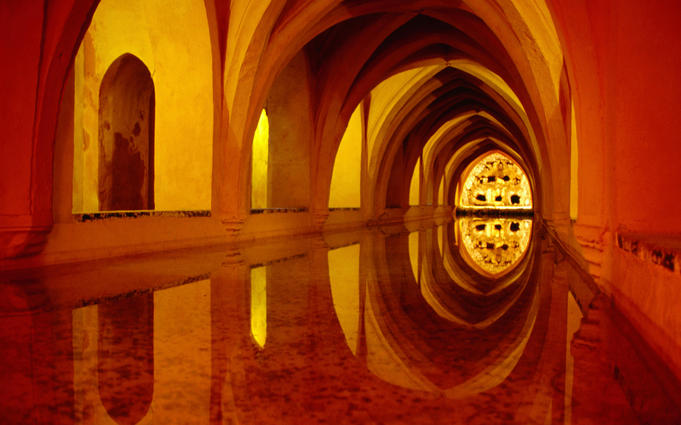
Rainwater tanks at Los Baños de Doña María de
Padilla, Seville, Spain c.1437-1572
Basilica Cistern, Istanbul, Turkey
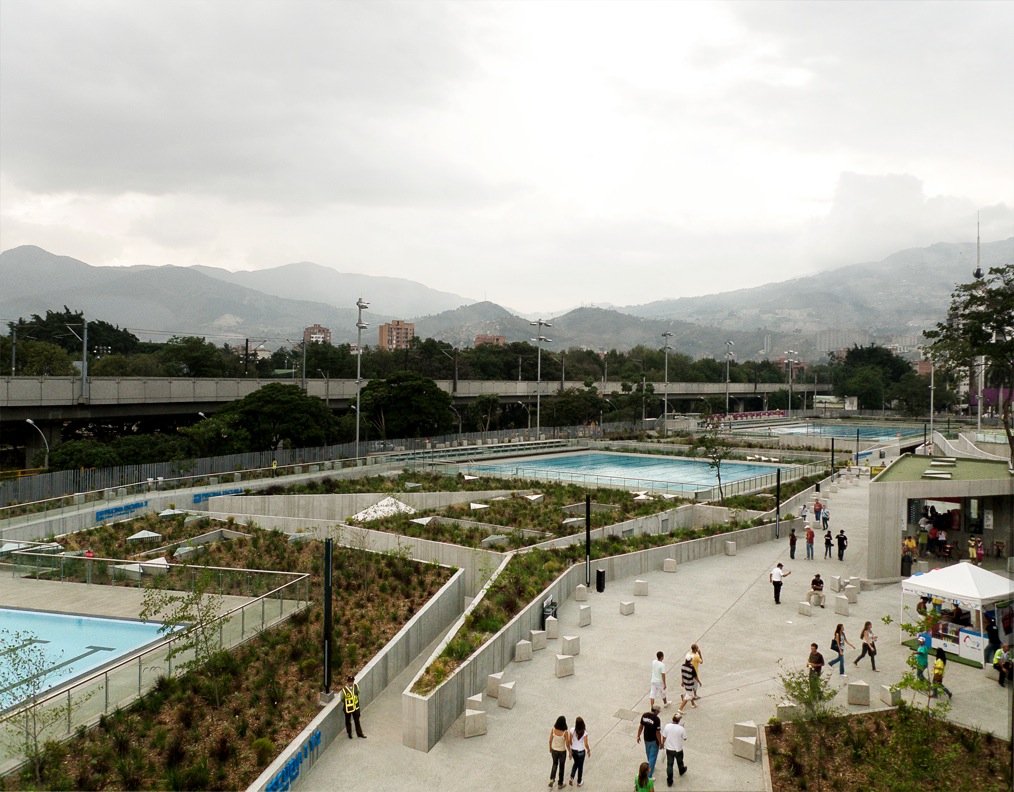
Aquatic Centre for Panamerican Games by Paisajes
Emergentes, 2010, Medellin, Columbia
References
Campbell, C. S. 1978, Water in Landscape
Architecture, Van Nostrand Reinhold, Berkshire, England
This project by Tonkin Zuliakha Greer and JMD continues
to be of influence upon this project. The experiential qualities of space,
particularly the vaulted underground halls, provide moments for exploration and
contemplation. The balance of old and new is deftly integrated; the new
building is highly restrained and responds fittingly to the heritage structure.
Considerations of atmosphere and overall experience for the visitor are the key
drivers for this project, making it a valuable source of inspiration.
As previously discussed on this blog the physical
presence of water has a very immediate result upon its surrounding environment.
Examining this further, the impact of introduction of water into a scheme can be
explored through the evocation of the senses. The three senses that Moore
identifies directly within Water and Architecture are sight, sound and
touch.
On Reflection
It is perhaps more appropriate to consider sight
under the heading of reflection and light, as these are the inherent qualities
of water to which Moore is directly referring. As water naturally seeks an even
surface, Moore suggests that capitalising on this very attribute can prove to
be a very powerful device for designers. Bouncing light off of the surface
Moore explains can allow designers to play with “the qualities of reflection,
depth, or the seemingly infinite surface of large bodies of water to relive
claustrophobia and expand personal space.” (Moore 1994:200)
OMGEVING’s Averbode Abbey Square in Belgium
demonstrates the dynamism of such effect. The water placed within this design, although only a few centimetres deep, undoubtedly achieves the intended pensive
qualities instilled by its simple composition. Throughout the day the ponds
reflect the sky and visitors catch glimpses of the buildings on the surface. By
night the space transforms, the buildings seem to float eerily in the middle of
the courtyards; their moorings to the earth are blurred. Here the successful
use of water as a reflective device is appropriate as it reminds the viewer of
the duality of human existence.
On Noise
Of equal consideration to that of the visual
aspects of water Moore suggests that sound has the potential to enhance a
design through careful consideration:
“…the sounds of water are variable and can be
manipulated to produce satisfying results. Water makes sounds as it splashes
against things, moves over solid objects, or falls into itself. Attention to
the audible aspects of water is important – too little sound can be annoying
[like a dripping faucet], and too much sound in confined spaces can be
overpowering…” (Moore 1994:202)
In a project where the intention is to heighten
the occupant’s awareness of the presence of water, sound can become a powerful
device - particularly within areas where the placement of water would be
inappropriate. Sound in this project, although hypothetical, can provide clues
to the relationship between certain spaces. The consideration deploying sound
as a device to curate experience across the site therefore goes hand in hand
with the introduction of silence. When considering the silence of water, Moore
explains:
“Silence, too, is appreciated. Water often
makes no sound at all, or very little, so people find emotional rescue in the
rare commodity of silence. Just the right amount of water noise can take the
edge off of silence, producing “white noise”. Drawing people to connect with
their stillness allows people to commune with the “indwelling spirit.” (Moore 1994:202)
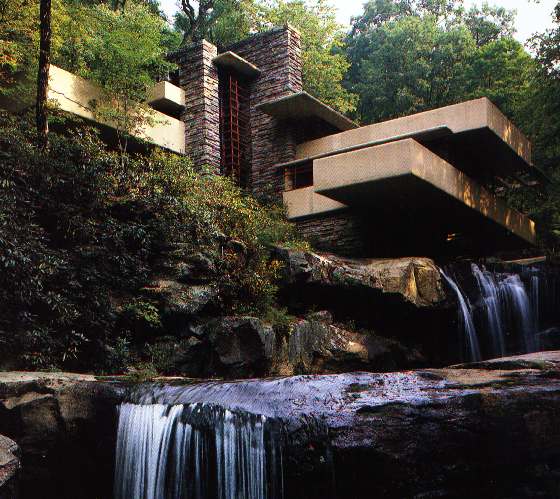
This is something Frank Lloyd Wright achieved at
Fallingwater. The audible flow of water can be heard within the structure
throughout the year. The sound of water triggers a connection for the occupants
to nature, refer attached video. It is important to note that the water that
will be integrated into this project will be nowhere near as close to the
naturally occurring as presented here. The challenge will be drawing on the
potency of this effect and considering how sound can be integrated will
contribute to the designing of experience within the project.
On Touch
Or perhaps as Michael Cadwell explains when
discussing Scarpa’s Querini Stampalia in his book 'Strange Details', the key for this
project is to counter and challenge the preconceived. Cadwell investigates the
odd nature of Scarpa’s work, analysing its ‘fluidity’ and highly organised
spatial arrangement. Cadwell explains that water is used as a relief, but one
that continues to detach the visitor from solid ground:
“We can breathe and there seems to be time…just
to go for a swim. A strange buoyancy fills the space. The water that first
terrified now gently lifts to the horizontal.” (Cadwell 2007:27)
Cadwell here and throughout his description of
Scarpa’s work is commenting on the relationship water possess with the
surrounding architecture and how it disorientates. This supports Moore’s
discussion of touching water being the most personal interaction we can have
with the substance. Moore explains touching water and the intimacy people
experience can vary through the altering the degrees of contact (Moore
1994:202). Like the presence of sound and the introduction of silence, the idea
of the untouchable can also heighten the emotional contact and overall
experience (Moore 1994:204). What is therefore called into question, by this
statement is the necessity to consider the edge of the water. The edge
condition, can have significant impact on the visitor; if it is railed it feels
safe, as there is a barrier between visitor and water. If there is no barrier,
the water can evoke emotions and trigger very personal responses. Cadwell’s
description of “the water that first terrified…” is testament to the careful
relationship Scarpa arranges with visitor and architecture.
To be critical of the Moore’s discussion of
water evoking the senses, he has omitted smell. And in relation to this
project, smell is a significant omission. The scent of a
wastewater treatment plant may possibly have a significant effect on a visitor. This provides the project with an avenue for exploration; how to mitigate the overpowering scent in certain places throughout the design. For this research to have greater yield for the
project it is necessary to refine its foci. This is identified through Moore’s
discussion of the ‘potential for wonder’ – where will water be
introduced and in what manner? As this project is the celebration of treating
wastewater. It becomes clear that the project must adopt the responsibility for
revealing this manufactured process to educate the people of Adelaide. Additionally the investigation into water infrastructure will provide clues on how to approach the more intricate relationships that are emerging within the design.
References
Cadwell, M. 2007, Strange Details, Writing
Architecture, Cambridge, MA : MIT Press
Moore, C. 1994, Water and Architecture, Harry N. Abrams
Inc., New York
The passage surrounding the ‘potential for
wonder’
in Charles Moore’s text Water and Architecture, which examines the fusing of water
and architecture, holds particular pertinence with this project. Here Moore
reveals two ideas. He comments on the increasing demand for the immediacy of
water to our daily lives and alludes to a coded language at the disposal of the
architect, almost an instruction manual. Themes that emerge relate to the
history and symbolism of water and the evocation of the senses, which will be
discussed in subsequent posts.
The position regarding the immediacy of water
raises an interesting point. As many is the case with developed societies, they
have grown accustomed to the availability and ease of access to clean water,
through its means of delivery. This severs the interaction between people and
the natural occurrence of the water cycle. Moore argues that the introduction
of “modern treatment plants have replaced the natural water cycle through the
mechanized hydrologic cycle of collection, filtration and sedimentation.”
(Moore 1994:198) It is hard not to agree with Moore on this subject, in turn
should more be done to heighten the public’s awareness of their detachment from
the natural cycle? - An important question to consider.
The observation of modern society’s dissociation
of the natural process combined with the history of water and the connection
with symbolism is relevant for this project. Moore understands that the use of
water within design “…fortifies connections to place, people, water and
nature…” and it is through these connections people are able to make sense of
the increasing complexity of the world (Moore 1994:199). Water possesses a
duality according to Moore, as it is both symbol and natural material:
“…Its use in architecture should reflect the
attitude of the about the natural world held by the people who design,
construct, or inhabit the building… At the end of the millennium we are faced
with the dilemma of balancing human needs with respect for nature. If water is
being used neither much nor well in our own architecture, then surely some of
the difficulty can be traced to our confusion over what sort of attitude toward
nature we are trying to express. Yet if we can effectively incorporate water’s
symbolism, history, and physical nature, then our water and our architecture
can have a potential for wonder unmatched by any other material that we can
include in our environments.” (Moore 1994:199)
There is something quite stirring about this
video. It is a 3D visualization, but nonetheless it captures exactly what Moore
is discussing. The sheer volume of the space hark back to another quote from
Moore:
“All of this effort is expended for the simple
reason that we need water to live… More than anything, designs involving water
and architecture must remind people of this dual impact that water has on our
lives.”
(Moore 1994:198)
These words hold particular resonance with the
space shown in this video - for this is the underground storm-water system in
Saitama. This is a $3 Billion USD system which protects Saitama during typhoon
season by diverting floodwaters away underground in these huge vaulted tunnels.
All this effort does in fact reminds people of the dual impact of water.
References
Moore, C. 1994, Water and Architecture, Harry N. Abrams
Inc., New York
“All of this effort is expended for the simple
reason that we need water to live… More than anything, designs involving water
and architecture must remind people of this dual impact that water has on our
lives.”
(Moore 1994:198)
'Aquatecture' by Anthony Wylson and 'Water
and Architecture' by Charles Moore are two texts that have proved to be quite pivotal
in clarifying the approach for this project. Both texts focus on the history
and theories behind the relationship of water and the built environment. They
reveal a discourse that enriches many of the decisions that have already been
made through theoretical grounding.
Water establishes itself as an integral component
when included within a design, Anthony Wylson explains. The inclusion of water
amenity will often reinforce a concern for natural water forms such as streams,
rivers and oceans along with the life-support system they provide (Wylson
1986:i). From an architectural position, this reinforcement for water confirms’ the human
obligation to understand the responsibility for the ecological functions that
water provides. Through its integration, water provides a dynamic, reflective
or experiential element for the built environment.
Within his text, 'Aquatecture; architecture and
water',
Wylson broadly examines the cultural and historical importance of water within
design. Through this examination it is possible to develop a position on humankind’s attitude towards water. Wylson declares:
“…water not only provides a basis for man’s
existence and a continuous challenge to secure its use, it is also a source of
metaphysical symbolism.” (Wylson 1986:3)
The chapter regarding ‘Water Corridors’ holds
particular resonance with this project, given its proximity to the River Torrens.
It is of Wylson’s view that amenity offered by the urban river corridor is twofold; it can provide opportunities for leisure and environmental enrichment,
yet reveal the neglected ecological aspects (Wylson 1986:71). This observation
aligns with the impetus for this project, yet some would be hesitant to call
Adelaide a ‘river city’ in its contemporary configuration. Whilst some
communities grew around the presence of water, it could be argued that
Adelaide, as a relatively young city, turned its back to the Torrens as it
developed. This may be a result of the rapid technological and economic progress Adelaide, like so many other ‘water corridor’ orientated civilisations, experienced which forced the natural amenity with the water source to become
disconnected (Wylson 1986:74).
The associations humans possess with water,
Charles Moore, suggests have been shaped by our ancestors. The understanding of
its symbolism is affirmed by the collected wisdom gathered over generations (Moore
1994:15). Moore presents an even more intriguing point when he suggests that
the key to understanding the relationship to water and architecture, is through understanding the physical laws which determine its behaviour. It is
through these laws humans have come to understand how this liquid interacts
with our senses, but as Moore suggests, its symbolism relates to human existence (Moore 1994:15). The importance of Moore’s text to this project is through the presentation of historic and contemporary architectural
manoeuvres which place water at the centre of design.
Incorporated within Moore’s text is his
diagrammatic study of the varying manipulations of water. Moore explains designers should concern themselves with the fluidity of
water in order to animate and enrich the experience of nature (Moore 1994:43)
again this view is reaffirmed when Moore suggests, “…water should appear alive.” (Moore 1994:203).
Moore is suggesting through this passage and its accompanying diagrams to
address how water exists in this place. This existence is defined by the manner
in which it announces its presence; is it tranquil, does it thunder, is there
movement? Each of these gestures carries with it philosophical meaning and
references a natural coding of this element. What Moore is leading the designer
to address, is to question whether there is life to the water? This is surmised
by the following quote:
“Any study of architecture and water has at its
disposal a rich history of meaning and tradition as well as a foundation in
mesmerizing physical and natural wonders. When the fusion of architecture and
water is treated carefully and creatively, the potential for meaningful
expression is practically limitless.” (Moore 1994:22)
References
Moore, C. 1994, Water and Architecture, Harry N. Abrams
Inc., New York
Wylson, A. 1986, Aquatecture: architecture and
water,
the Architectural Press Ltd, London
Original diagrammatic study by Charles Moore, found in Water and Architecture pp. 44-45
The
second film to be released by photographer Edward Burtynsky and filmmaker Jennifer
Baichwal will look at “…the ways in which humanity has shaped, manipulated
and depleted one of its most vital and compromised resources: water.”
Burtynsky
and Baichwal’s first film ‘Manufactured Landscapes’ (2006) is a documentary
where the audience follow Burtynsky’s journey across Asia through Baichwal’s
camera. The power of the film comes by way of the absent opinion of the
conditions revealed on Burtnysky’s journey. The film is a device that frames
and captures a realistic, un-biased, a-political view of the world - forcing
the viewers to experience or pass their own response to what they witness.
Burtynsky’s images capture the sublime through
the framing of the ‘unseen’; it will be exciting to see how this pair captures
the ‘life’ that is embodied in liquid. The film is scheduled to be released in
Canadian theatres on October 11 2013 and opens in Toronto on September 27 2013.
Hopefully it will make it on to the program for the Adelaide Film Festival!
An
interesting event occurred on February 2nd 2009 (Noonan: 2009). The
Sluice Gate on the Gorge Weir, which controls the level of water in the Torrens
Lake, malfunctioned. Subsequently millions of litres of water were flushed out
to sea and the two metre deep lake was reduced into a mud flat overnight.
The
Torrens holds an interesting place within Adelaidean society; for many years
the precinct has sat idly by - almost neglected given its ‘colourful history’.
Given its proximity to the city it has always raised sparked, passionate debate
as to the possibilities the space could, or should provide the people of
Adelaide. Interestingly when the river emptied during that summer, its
condition was thrust into public focus. With ‘Mad March’ fast approaching the
inability to refill the lake, due to water restrictions across the state at the
time, compounded the city’s neglect of their ‘Jewel’.
With its contents emptied, the lakebed revealed numerous objects
including bikes, car bodies, shopping trolleys and tyres (Noonan: 2009).
Ironically during the time the lake was emptied, the Riverbank Precinct (as it
is now known) saw an increase of curious visitors. Given the looming future
water management challenges facing South Australia - could the exposure of the
Torrens Lake be considered as a premonition? If anything, this event highlights
the importance of the River Torrens as a delicate and integral component of the
fabric of Adelaide. Even if the current condition of the River is in fact a
controlled, artificial and far removed from its natural existence, what is
revealed through events such as this is the responsibility the people of
Adelaide have to the ecological condition of this place.
More information regarding the
Riverbank Precinct can be found here:
http://www.riverbank.sa.gov.au/
Noonan, T. 2009, The Mudflats
formerly known as Torrens Lake, http://www.abc.net.au/local/stories/2009/02/12/2489270.htm,
accessed 03.08.2013