As previously discussed on this blog the physical presence of water has a very immediate result upon its surrounding environment. Examining this further, the impact of introduction of water into a scheme can be explored through the evocation of the senses. The three senses that Moore identifies directly within Water and Architecture are sight, sound and touch.
On Reflection
It is perhaps more appropriate to consider sight
under the heading of reflection and light, as these are the inherent qualities
of water to which Moore is directly referring. As water naturally seeks an even
surface, Moore suggests that capitalising on this very attribute can prove to
be a very powerful device for designers. Bouncing light off of the surface
Moore explains can allow designers to play with “the qualities of reflection,
depth, or the seemingly infinite surface of large bodies of water to relive
claustrophobia and expand personal space.” (Moore 1994:200)

OMGEVING’s Averbode Abbey Square in Belgium
demonstrates the dynamism of such effect. The water placed within this design, although only a few centimetres deep, undoubtedly achieves the intended pensive
qualities instilled by its simple composition. Throughout the day the ponds
reflect the sky and visitors catch glimpses of the buildings on the surface. By
night the space transforms, the buildings seem to float eerily in the middle of
the courtyards; their moorings to the earth are blurred. Here the successful
use of water as a reflective device is appropriate as it reminds the viewer of
the duality of human existence.
On Noise
Of equal consideration to that of the visual
aspects of water Moore suggests that sound has the potential to enhance a
design through careful consideration:
“…the sounds of water are variable and can be
manipulated to produce satisfying results. Water makes sounds as it splashes
against things, moves over solid objects, or falls into itself. Attention to
the audible aspects of water is important – too little sound can be annoying
[like a dripping faucet], and too much sound in confined spaces can be
overpowering…” (Moore 1994:202)
In a project where the intention is to heighten
the occupant’s awareness of the presence of water, sound can become a powerful
device - particularly within areas where the placement of water would be
inappropriate. Sound in this project, although hypothetical, can provide clues
to the relationship between certain spaces. The consideration deploying sound
as a device to curate experience across the site therefore goes hand in hand
with the introduction of silence. When considering the silence of water, Moore
explains:
“Silence, too, is appreciated. Water often
makes no sound at all, or very little, so people find emotional rescue in the
rare commodity of silence. Just the right amount of water noise can take the
edge off of silence, producing “white noise”. Drawing people to connect with
their stillness allows people to commune with the “indwelling spirit.” (Moore 1994:202)
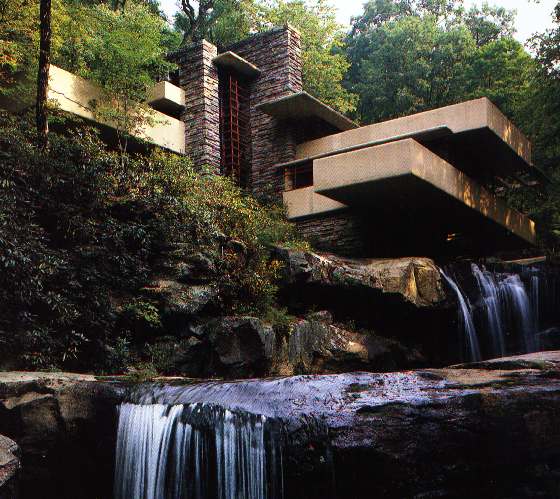
This is something Frank Lloyd Wright achieved at
Fallingwater. The audible flow of water can be heard within the structure
throughout the year. The sound of water triggers a connection for the occupants
to nature, refer attached video. It is important to note that the water that
will be integrated into this project will be nowhere near as close to the
naturally occurring as presented here. The challenge will be drawing on the
potency of this effect and considering how sound can be integrated will
contribute to the designing of experience within the project.

On Touch
Or perhaps as Michael Cadwell explains when
discussing Scarpa’s Querini Stampalia in his book 'Strange Details', the key for this
project is to counter and challenge the preconceived. Cadwell investigates the
odd nature of Scarpa’s work, analysing its ‘fluidity’ and highly organised
spatial arrangement. Cadwell explains that water is used as a relief, but one
that continues to detach the visitor from solid ground:
“We can breathe and there seems to be time…just
to go for a swim. A strange buoyancy fills the space. The water that first
terrified now gently lifts to the horizontal.” (Cadwell 2007:27)
Cadwell here and throughout his description of
Scarpa’s work is commenting on the relationship water possess with the
surrounding architecture and how it disorientates. This supports Moore’s
discussion of touching water being the most personal interaction we can have
with the substance. Moore explains touching water and the intimacy people
experience can vary through the altering the degrees of contact (Moore
1994:202). Like the presence of sound and the introduction of silence, the idea
of the untouchable can also heighten the emotional contact and overall
experience (Moore 1994:204). What is therefore called into question, by this
statement is the necessity to consider the edge of the water. The edge
condition, can have significant impact on the visitor; if it is railed it feels
safe, as there is a barrier between visitor and water. If there is no barrier,
the water can evoke emotions and trigger very personal responses. Cadwell’s
description of “the water that first terrified…” is testament to the careful
relationship Scarpa arranges with visitor and architecture.

To be critical of the Moore’s discussion of
water evoking the senses, he has omitted smell. And in relation to this
project, smell is a significant omission. The scent of a
wastewater treatment plant may possibly have a significant effect on a visitor. This provides the project with an avenue for exploration; how to mitigate the overpowering scent in certain places throughout the design. For this research to have greater yield for the
project it is necessary to refine its foci. This is identified through Moore’s
discussion of the ‘potential for wonder’ – where will water be
introduced and in what manner? As this project is the celebration of treating
wastewater. It becomes clear that the project must adopt the responsibility for
revealing this manufactured process to educate the people of Adelaide. Additionally the investigation into water infrastructure will provide clues on how to approach the more intricate relationships that are emerging within the design.
References
Cadwell, M. 2007, Strange Details, Writing
Architecture, Cambridge, MA : MIT Press
Moore, C. 1994, Water and Architecture, Harry N. Abrams
Inc., New York
Image References
1. Averbode Abbey Square by OMGEVING, 2012, Scherpenheuvel-Zichem,
Belgium. Image found at http://www.landezine.com/index.php/2012/09/averbode-abbey-square-by-omgeving/,
accessed 25.08.2013
2. The Kaufmann Residence known as “Fallingwater”
by Frank Lloyd Wright, 1935, Pennsylvania, United States. Image found at http://www.wright-house.com/frank-lloyd-wright/fallingwater-pictures/fallingwater-2.jpg,
accessed 27.08.2013
3. Querini Stampalia by Carlos Scarpa, 1959-63,
Venice, Italy. Image found at http://www.mzetastudio.it/image/Fondazione%20Querini%20Stampalia%20072.jpg,
accessed 27.08.2013
Video Reference
Fallingwater – A Frank Lloyd Wright House Video,
found at http://www.youtube.com/watch?v=DcGnijrFrqU,
accessed 27.08.2013


No comments:
Post a Comment